BIRTH AS THRESHOLD - knowledge forgotten but remembered
The word threshold is appearing more and more in conversations about birth, it's worth paying attention to because it may be that collectively we are recognising the deeper threads that sit beneath our experiences of the big moments, the hard work, the powerful change.
This is not a new idea. It's ancient wisdom, woven into art, stories, music and language for thousands of years. It's part of what makes us human, maps our evolution and growth as a species, and is mirrored in every person.
It reaches back through depth psychology, through mythology, through the stories human beings have been telling about themselves for as long as we've been telling stories.
We often reach for the word "journey" when we talk about how people grow and change, and while that word has become a little worn through overuse, it points to something that is as important to our existence as water and food.
The template to this type of growth shows up in fairy tales, in mythology, in the films and books we return to again and again, because something in us recognises the shape of it in trials, suffering. There is a familiarity to it that brings comfort.
The descent into the unknown takes courage which then gifts us a discovery of inner resources we didn't know we had. And then the return when we are changed, stronger and more fully ourselves, not different but more. Jung called this individuation, it was then called the hero's journey by Joseph Campbell.
Birth is one of the most clearly defined and most profound examples of it we will ever encounter.
The guardian at the birth gate
In mythology, the threshold is never just a door you walk through. It's guarded. Think of Cerberus, the three-headed dog standing at the entrance to the underworld in Greek mythology. It may be a dragon or a troll but it's always a formidable, terrifying presence that must be faced before the journey can begin at all.
This fearsome guardian represents your own fears of birth. These are ones that are outside of your awareness, the shadow.
This may be fear of pain, a fear of losing control, fear of the unknown. Perhaps even the fear of what birth actually is and what it will ask of you. These fears are the guardians at the threshold of birth, and they are real. They need to be acknowledged, not dismissed. But the task is not to eliminate them or ignore them, the task is to find the courage to face them, understand them and cross them anyway.
That distinction matters. What's useful is building the capacity to hold fear without being consumed by it, this is a form of power that will help to withstand any diversions in the path. To stand at the gate, look at what's there, and move through regardless. That is courage. It's a skill that can be learned, practised, developed in the months before birth.
The women who tend to do best in labour are rarely the ones without fear. They're the ones who met their fear beforehand and found a way to keep moving. The process you go through when you prepare for birth with your thoughts and feelings in mind goes deeper than just a few breathing techniques.
The circular journey of pregnancy, birth and motherhood
Once you've crossed that threshold, the journey is not linear. It's a circle.
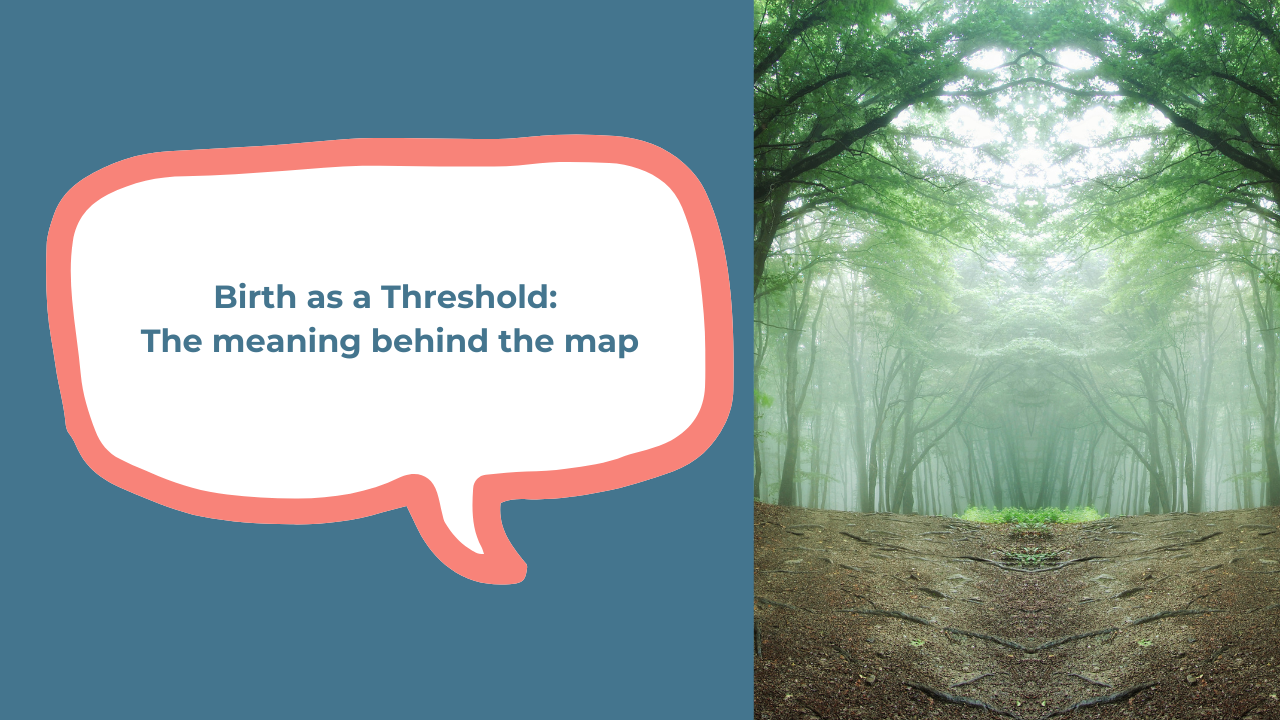
It begins the moment you know you're pregnant, that first awareness that something enormous lies ahead. From there you walk your path through pregnancy, moving deeper into the forest, into its unfamiliar darkness. No one can do that walking for you. People can travel alongside you. Partners, midwives, doulas, women who have crossed this threshold before and carry something of that knowing in their bodies. But the path is yours and yours alone.
At the base of that circle, 180 degrees from where you began, labour starts. This is the descent. The deepest and darkest point. At this point order is upturned, power shifts, taboos are broken, rules are upended.
In the heart of this space freed from the shackles of prediction you discover things about yourself you didn't know were there, things your body can do that you didn't know it could do. It demands everything. Focus, strength, surrender. And when you come through it, you know more about yourself and what you're capable of.
Then the circle turns upward. You emerge with a reward, and you integrate. You are not quite the same person you were when you stepped onto the path, you are more.
The people you meet on the way
The journey throws challenges, otherwise it would not be a rite of passage! These take different forms, and tempt you off your path. The real challenge here is to stick fearlessly to what matters to you.
Tricksters and the courage to stay the course
Once you're inside the forest, the danger shifts. The guardian is behind you. What you meet now are tricksters, and they are a different kind of challenge entirely.
Tricksters don't confront you head on. They divert you. They appear kind, reasonable, even helpful. This is precisely what makes them so effective. Little Red Riding Hood doesn't leave the path because she's foolish. She leaves it because the wolf is charming, the conversation is easy, and the flowers look beautiful. Snow White doesn't take the apple because she's careless. She takes it because the witch appears as a harmless old woman offering something nourishing. The trickster's gift is that they rarely look like a threat.
In pregnancy, tricksters take familiar forms. A comment from someone well-meaning that plants a seed of doubt. A test result framed in a way that pulls your attention toward fear. Advice that sounds reasonable but slowly disconnects you from what you actually know and want. These are the things that can move you off your path, not dramatically, but gradually, until you've lost the thread of your own values and intentions.
This is where courage appears again, and in a quieter form. It's asking you to pay attention to what is yours to take on and to recognise what is pulling you sideways. Staying connected to what matters to you even when the forest is trying to disorient you takes clarity of heart and connection with your truth.
Contrast this with Hansel and Gretel, both children in a genuinely terrifying situation, abandoned, lost, with every reason to panic. What keeps them is exactly this: they hold their nerve, they think clearly, they trust each other and follow the trail home. They don't pretend the danger isn't real. They move through it anyway.
Knowing your values before labour begins is part of this preparation. Not a rigid birth plan, but a genuine sense of who you are, what matters to you, and how you want to move through this experience. That inner compass is what keeps you oriented when the tricksters appear, and they will appear, because that's what thresholds do. They test whether you really know yourself.
Thresholds within thresholds
What's particularly interesting about birth is that it contains thresholds within itself.
Pregnancy is its own threshold, that long walk through the forest toward something you cannot fully see. The doubt and ambiguity that makes motherhood so challenging. You may hear yourself think "I'm going to be pregnant forever" even though at the same time you know it's not possible.
Then labour begins, and there is the moment when there is no going back. A second crossing. And then transition, that moment most women encounter when they feel they genuinely cannot continue. The darkest part of the forest. The place where the trickster whispers most loudly that there is no way through.
But there is no way out. There is only through. And that's where the preparation matters, not because it protects you from the difficulty, but because it resources you for it. The courage to face the guardian at the beginning, the discernment to recognise the tricksters on the path, the mentors you've drawn in around you. You carry all of that into labour, and it is what sees you through.
Transition in labour is the threshold within the threshold. The moment, in the old language, of crossing from maiden to mother. And then suddenly there is light at the edge of the forest, the baby is born, and the darkest part of that place is behind you.
Your baby's threshold
It's worth pausing to note that birth is a threshold for your baby too. Perhaps their first. Perhaps their second, depending on your perspective on what came before. They are moving from one world into another, crossing in parallel with you. Two people, one threshold, each making their own way through it.
Integration, and what we're missing
Where I think we lose something significant in modern maternity care is in what happens after the crossing. Integration. The conscious return.
When you give birth, you are in an altered state. Time works differently, there's a Greek word for it, kairos, a moment between moments where ordinary chronological time doesn't apply. Because of this, there are aspects of birth you won't fully remember in the way you'd access a normal memory. That isn't a failure of memory, it's the nature of giving birth.
This is why things like birth reflection, birth processing, the closing of the bones ceremony, being wrapped and held and called back into yourself, matter. They're part of the journey. They help you make sense of the timeline, integrate what happened, and arrive more fully in the life that begins on the other side. The postnatal period is the last arc of the circle, the movement back into the world with your baby, and it deserves the same care and intentionality as everything that came before.
Why this matters
I don't expect this to resonate with everyone, and that's fine. But for some people something in it will be recognised rather than learned. Because this is what the hero's journey is: a map of something we already know. We recognise it in stories because it's the shape of our own becoming.
Birth asks you to face your guardian, to name your fear and cross toward it anyway. It asks you to stay the course when tricksters appear in convincing disguises. It asks you to go further into yourself than you may ever have been required to go before and to discover, in that depth, something you didn't know was there.
The preparation for that isn't just physical. It's psychological. It's the work of knowing yourself well enough that the forest doesn't disorient you, and courageous enough to keep moving when it tries to.
The only way is through and how you choose to do that will leave you feeling as if you discovered something about yourself, a power you didn't know you had, or it can leave you feeling a sense of grief that you missed out on something that mattered, but not knowing exactly what that was. That grief is real, and it matters. It's often the thing that brings women to do this work second time around, or that stays quietly unresolved for years. It deserves to be named.
If you'd like to explore this work before your birth, you can find out more about my online hypnobirthing course or work with me one to one at sophiefletcher.co.uk
Stay connected with news and updates!
Join my mailing list to receive the latest news and updates.
Don't worry, your information will not be shared.
I hate SPAM. I will never sell your information, for any reason.
