
Liminal spaces and everyday life
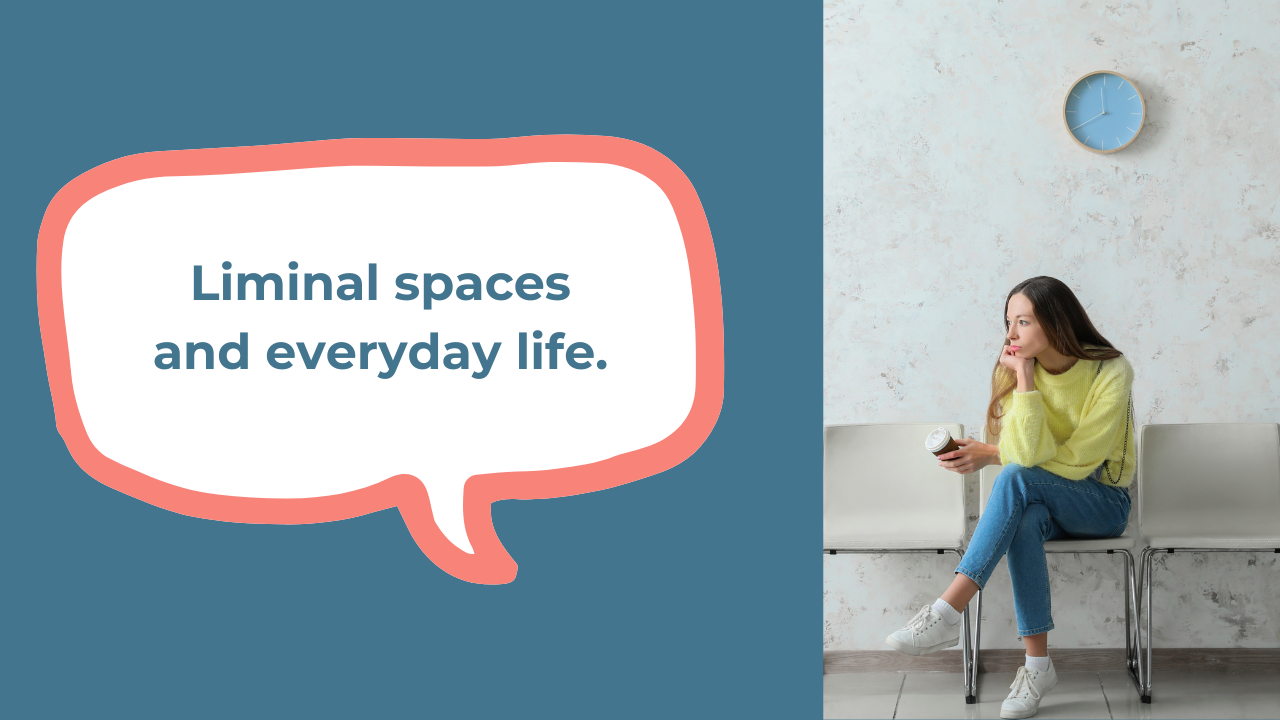
At the moment I'm in a waiting room, or that's what it feels like. I didn't plan to be here, but suddenly my children came home with degrees and a sense of "what's next". For three months they wrestled final year projects, and I wrestled 7am calls, and before I could blink we were trundling down the A1 with three years of independent life crammed into the back of a Golf. (Reader, it took two journeys and six hours of driving.) Then another five hours up the A1 with the other one.
It just happened, and while they are in this liminal space, as their mother I have found I am too. The threads of work I was focused on seem to be suspended in midair as my time is taken up with holding space, managing the restless discomfort that makes little sense to two young people in their early 20s. The "what's next".
This is the space between one thing ending and the next thing beginning. Often you find yourself in it after having stepped into it without quite realising the door had closed behind you.
I wonder whether you are in that space now?
Maybe, like me, it's when your children came back from university, are home from school, or are preparing to go to school, and the architecture of your week has dissolved. The threads you were holding, the work, the rhythm, the shape of your days, all loosened at once and are like you, waiting. There's no pattern yet. No scaffolding. You can see where you've come from; you may sense where you're going. But you're not there yet.
This is what liminal space feels like.
It's not comfortable. There's an unidentifiable restlessness in it, a low-level apprehension that sits beneath everything. The part of you that knows how to organise and build and move forward is looking around for a handrail, and there isn't one. You are being asked to allow something to reorganise without pushing it, and to find a way to sit in that space, allowing life to reform around you.
Or maybe you're at a different threshold. You're standing at the edge of motherhood, waiting for labour to begin. Your body is doing something extraordinary, but it's not dramatic yet. It's not urgent. It's just happening. The preparation is done. And now you're waiting. The baby is coming, but not yet. You're standing in the threshold between the life you've known and the life that's about to begin. You can't hurry it. You can only allow it.
You might be in perimenopause. The change is coming. Your body knows it. Your nervous system senses it. But you're not on the other side yet. You're in the suspension between cycles, between hormones, between one version of yourself and the next. The old patterns are loosening. The new ones haven't landed. You're waiting for your own body to finish its work.
Or you're standing in your child's bedroom looking at the school uniform hanging on the door, and something in you knows that the familiar is about to dissolve. Your five-year-old doesn't have words for it yet, but they feel it too. Something ahead is not yet understood, not yet within reach. There's an apprehension that's completely accurate, because something real is about to change.
There's a deeper part of you that understands that change is ahead, and your threat system can feel slightly raised, preparing for the unexpected.
Understand What You're Experiencing
The threshold has always been understood as something sacred. In mythology, the liminal space is where transformation happens. It's not the destination. It's the crossing that matters.
Jung wrote extensively about this threshold you're standing in right now. He described it as essential to psychological development. The passage through the underworld, the hero's descent, the necessary death before rebirth aren't simply metaphors. They're descriptions of what has to happen psychologically when you move from one stage of life to another. The liminal space is where the old version of you is undergoing change and the newer version has not yet been born. It's a genuinely vulnerable place, and that vulnerability is not a weakness. It's the condition for your transformation.
It's often described as death and rebirth. Personally, I don't see this transition as a death, but as an evolution. We are more than we were before.
Heraclitus understood something you're probably sensing right now. Everything flows. Nothing stands still. The river you step into today is not the river you stepped into yesterday, because the river is always becoming something else. You're living in constant flux, and this moment, right now, in the waiting, is when that flux becomes visible. This is when you can actually feel the shift happening. This is your liminal space.
Traditional cultures knew how to mark what you're going through. There were rituals for the threshold. Not to make it disappear, but to create a holding space for it. To say: "This is real. This is important. This matters. We are witness to your crossing."
A young person going through initiation was taken out of ordinary life. There was time set apart. A space that was explicitly not the before and not the after. It was the between. And in that between, something happened. The person on the other side of it was different from the person who entered.
When you gave birth or were about to give birth, that passage was marked as a threshold. Women were given time, real, protected time, to cross into motherhood without the demands of ordinary life. Menopause was honoured as a passage into a different kind of power and authority. Your passage was given weight and recognition.
We've largely stopped doing this, and when a space isn't held or witnessed, feelings come up in other ways and can bubble over. You may notice frustration, anger, impatience, inertia, anxiety, a drive to do something but instead an experience of brain fog.
The Contemporary Ache: What You're Actually Doing
While culture has removed the structures, the need for those structures still exists. Your soul still recognises a threshold when it's coming and knows that your body still needs to cross.
So now you're seeking them out. Intuitively. Often without naming what you're doing.
Maybe it's taking a gap year. It's not an accident. It's a deliberate choice. A young person finishes school and travels. You may take a long walk, physically imprinting movement from one destination to another. Maybe it's an interrailing trip across Europe, or researching pilgrimages or retreats. These aren't casual decisions. You're answering a clarion call from your soul.
A menopause circle, a mother's circle, a birth blessing, or a life transition circle. Women sitting together specifically to mark and move through a passage. These are recreations of old knowledge, happening in new forms.
If you're planning a babymoon, a pregnancy retreat, or a midlife retreat, you're deliberately creating space to be in a threshold with intention.
How to Honour Your Liminal Space
When you find yourself in this space, stop and recognise it. Pay attention to what is happening, and acknowledge that you can't force it. Stop treating it as a problem, and learn how you can create the space for the next stage to unfold around you.
It might be as simple as a daily walk where you deliberately notice the crossing, from home to elsewhere and back again. A small pilgrimage that marks the threshold between one part of your day and another.
It might be sitting with someone else who's in a threshold moment and just being present. Not solving or fixing it but just witnessing that yes, this is real, this is hard, this is where transformation happens.
It might be a journal that becomes the space where you let the unsettled thoughts move through you.
It might be creating a small ritual, a candle, a moment of pause, a few conscious breaths, that accepts "I'm in this space. This matters. I'm not rushing it".
It might be seeking out the community, the circle, the mentor who understands how it is to be in this space.
You may be the person who finds themselves holding a space for someone else, when you want to do other things.
Your practice is the same whether you're a five-year-old in a new uniform, a woman in perimenopause, or someone standing on the edge of a new life chapter: you're learning to stay present in your own reorganisation without needing to rush it into shape.
The Gift That's Waiting for You
Jung understood that every threshold crossing leaves you different. Not better or worse. Just different, more integrated. Wiser in a way that can only come from having stood in the unknown and let it reshape you.
The liminal space is where you become someone else. Below the threshold of conscious awareness, something is reorganising, and your sense of what's possible shifts. Your relationship to your own strength changes. Your understanding of what you can bear deepens.
But this only happens if you're willing to be in the space, lean into the discomfort of not knowing, and trust that what is for you will come to you.
If you recognise yourself somewhere in this, in the waiting room, at the school gate, in the space between one version of you and the next, you don't have to hold it alone. I work with women navigating exactly this kind of transition, whether that's birth, perimenopause, or the quieter thresholds of everyday life, offering support and self-hypnosis audio tracks designed to help you find steadiness while you cross.
Contact me to find some support for the threshold you're standing at and book a session to set an intention goal, or build a track that helps you honour that space.
FAQ
What is a liminal space? A liminal space is the psychological, and often physical, space between one stage of life and the next, where the old pattern has ended but the new one hasn't yet formed. Birth, graduation, perimenopause and career change are all common liminal spaces.
How do you cope with a difficult life transition? Rather than rushing to fill the gap, it helps to recognise the transition for what it is, create small rituals that mark the crossing, and allow the discomfort of not knowing to be part of the process rather than a problem to fix.
Where can I find support during a period of change? Support can come from community, a mentor, or tools such as guided audio and self-hypnosis that help regulate the nervous system while you're in the in-between.
This blog was written by Sophie Fletcher author of Mindful Hypnobirthing, Mindful Mamma and Mindful Menopause.
Stay connected with news and updates!
Join my mailing list to receive the latest news and updates.
Don't worry, your information will not be shared.
I hate SPAM. I will never sell your information, for any reason.
